Με την βοήθεια μίας φίλης από το
Mosaicology παραθέτουμε μετάφραση αποσπασμάτων από μία αξιόλογη εργασία που βρήκαμε στα αγγλικά. Πηγή κειμένου και μερικών φωτογραφιών από το
bluffton.edu
Apse Mosaics (before the middle of the 6th cent)
Ψηφιδωτά της κόγχης του ιερού (πριν από τα μέσα του 6ου αι.)
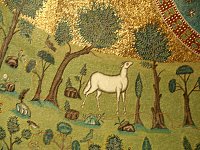
In the lower part of the apse Saint Apollinare is depicted in the center of a green landscape. Saint Apollinare, the first bishop of Ravenna, is robed in a white dalmatic and purple tunic, embroidered with bees, symbolizing eloquence. He is in the early Christian "orant" position--with outstretched arms praying. Twelve lambs are at his feet, symbolizing the community of the faithful. This figure also symbolically recalls Christ as the Good Shepherd, with the twelve sheep then representing Christ's Disciples.
***
Στο κάτω μέρος της κόγχης ο Αγ.Απολλινάριος απεικονίζεται στο κέντρο ενός πράσινου τοπίου. Ο Αγ.Απολλινάριος, ο πρώτος επίσκοπος της Ραβέννας, φοράει χιτώνα χρώματος άσπρου και μωβ, με κεντημένες μέλισσες που συμβολίζουν ευφράδεια. Βρίσκεται σε στάση δέησης (orans) με τα χέρια απλωμένα προς τα πάνω. Δώδεκα αμνοί βρίσκονται στα πόδια του, συμβολίζοντας την κοινωνία των πιστών. Η μορφή αυτή ανακαλεί επίσης και τον Χριστό σαν τον καλό ποιμένα με τα δώδεκα πρόβατα να αντιπροσωπεύουν τους μαθητές του.
Elements of the landscape are isolated and arranged symmetrically and no attempt is made to depict deep natural space.
***
Τα στοιχεία του τοπίου είναι απομoνωμένα το ένα από το άλλο και διευθετημένα με τρόπο συμμετρικό χωρίς να επιδιώκεται η απεικόνηση του φυσικού χώρου βάθους.
The jeweled cross
Ο κοσμημένος σταυρός
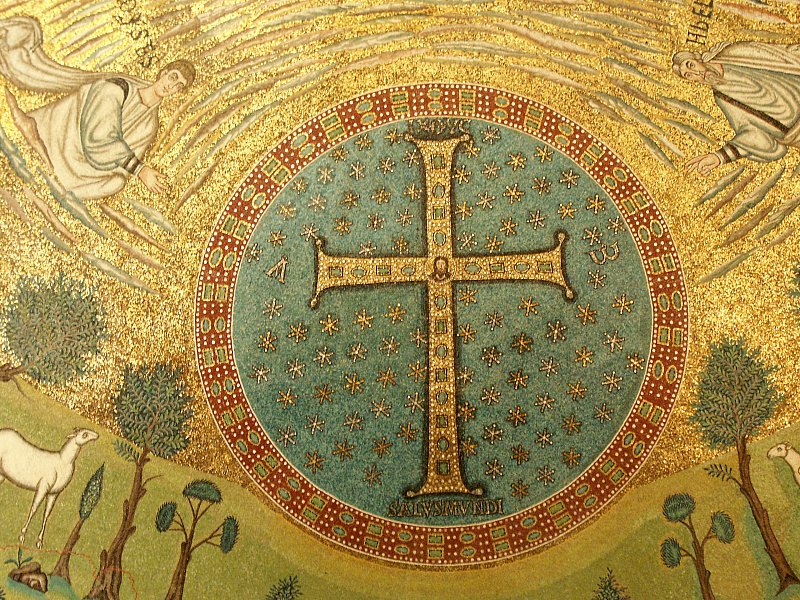
At the top of the cross the Greek word for fish appears, an acrostic formed by the initials of five Greek words meaning "Jesus Christ, Son of God, the Savior." The alpha and omega appear at the sides--the last letters of the Greek alphabet, used symbolically by Christ in the Apocalypse to signify that he was the beginning and the end. Below the cross are the words Salus Mundi, Salvation of the World. Rather than depicting an event narrated in the Bible, this mosaic indicates important theological and symbolic ideas.
***
Επάνω από τον σταυρό εμφανίζεται η ελληνική λέξη ιχθύς σε μία ακροστοιχίδα διαμορφωμένη από τα αρχικά των πέντε ελληνικών λέξεων που σημαίνουν Ιησούς Χριστός, Θεού Υιός Σωτήρ. Το άλφα και το ωμέγα εμφανίζονται στις πλευρές--τα τελευταία γράμματα του ελληνικού αλφαβήτου, χρησιμοποιούμενα συμβολικά από τον Χριστό στην Αποκάλυψη για να υποδηλώσουν ότι Αυτός είναι η αρχή και το τέλος. Κάτω από τον σταυρό βλέπουμε τα λόγια Salus Mundi, Σωτηρία του κόσμου. Αντί να απεικονιστεί ένα γεγονός από την Βίβλο, το ψηφιδωτό αυτό υποδεικνύει σημαντικές θεολογικές και συμβολικές ιδέες.
Triumphal arc mosaics
Ψηφιδωτά της αψίδας θριάμβου
The chronology of the arch mosaics is debated, with dates for their execution varying from the 6th to the 12th century.
Dated to the 9th century, the upper register here depicts a bust of a bearded Christ giving a blessing. On each side on a blue background with clouds are the four symbols for the Evangelists, winged figures holding books--the eagle (John), angel (Matthew), lion (Mark) and the ox (Luke).
Η χρονολογία των ψηφιδωτών της αψίδας θριάμβου είναι αμφίβολη με ημερομηνίες για την κατασκευή τους που υπολογίζονται από τον 6ο ως τον 12ο αιώνα.
***
Χρονολογούμενο στον 9ο αι., το έργο στην κορυφή απεικονίζει μία προτομή του Χριστό με γένια που ευλογεί. Στην κάθε πλευρά και σε μπλε φόντο βρίσκονται τα τέσσερα σύμβολα των Ευαγγελιστών ανάμεσα σε σύννεφα σε μορφές με φτερά κρατώντας βιβλία--ο αετός (Ιωάννης), άγγελος (Ματθαίος), λιοντάρι (Μάρκος) και ο ταύρος (Λουκάς).
The date palms
Τα φοινικόδεντρα
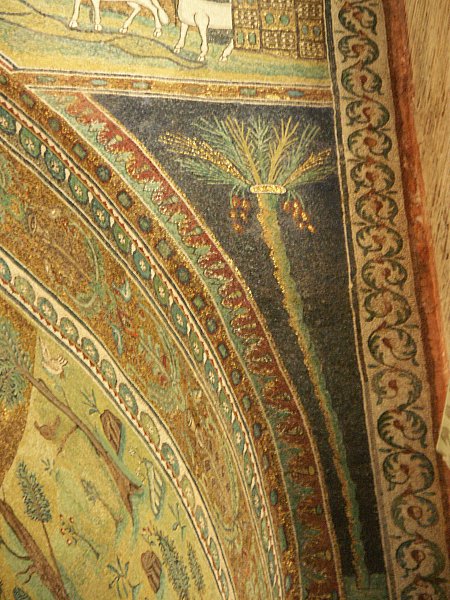
Yet a lower zone, dated to the 7th century, depicts two palm trees, recalling the verse of the psalm "the just man will flower like the palm."
***
Όμως ένα χαμηλότερο τμήμα, που χρονολογείται στον 7ο αι, απεικονίζει δύο φοινικόδεντρα, ανακαλώντας τον στίχο του ψαλμού "Ο δίκαιος ως φοίνιξ θέλει ανθεί".